Add your promotional text...


Below you can view our full introduction of flagpole accessories, material selection and professional technical knowledge.
Flagpole Accessories & Stainless Steel Flagpole Technical Knowledge
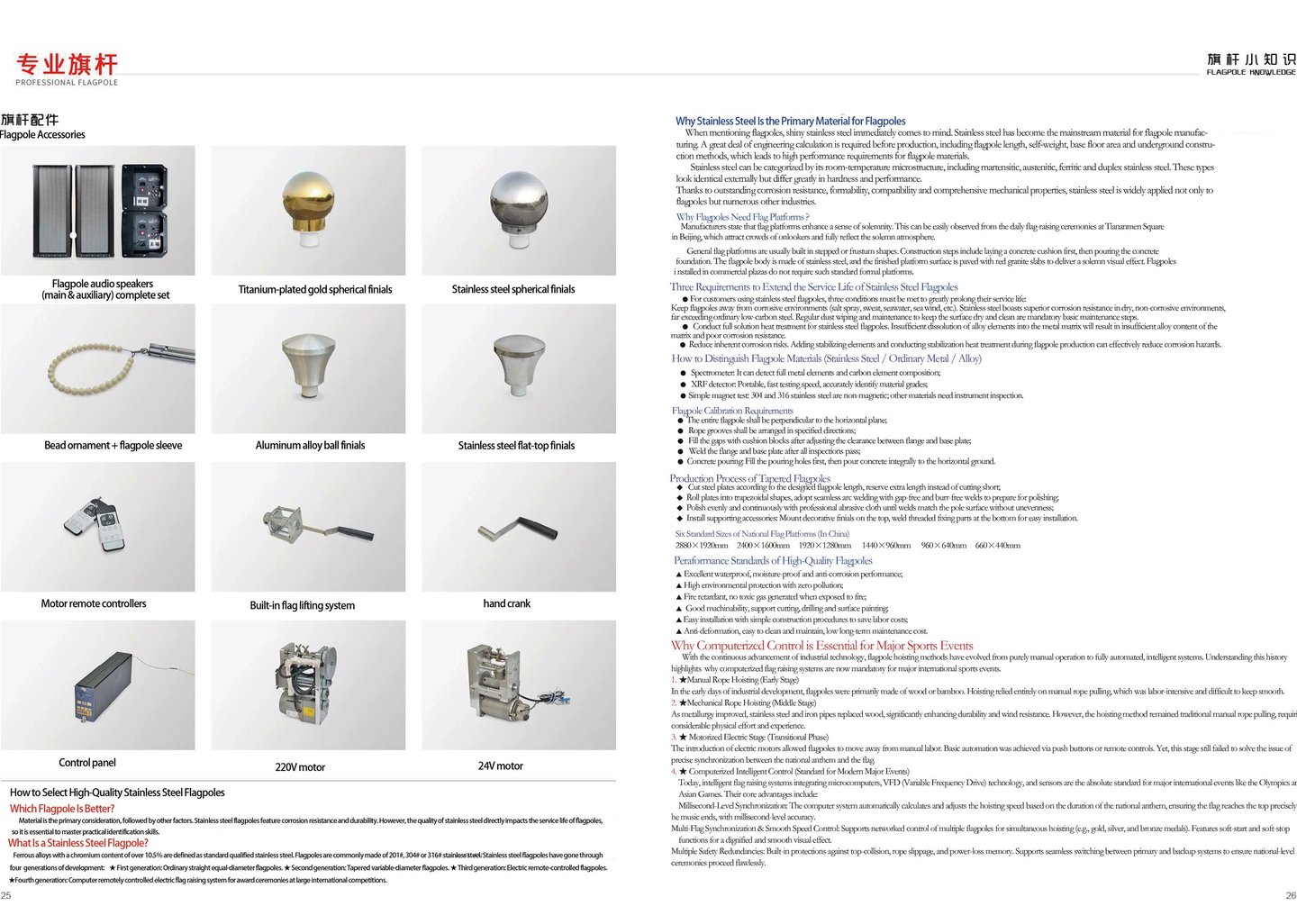
Flagpole Accessories
Flagpole audio speakers (main & auxiliary) complete set
Titanium-plated gold spherical finials
Stainless steel spherical finials
Bead ornament + flagpole sleeve
Aluminum alloy ball finials
Stainless steel flat-top finials
Motor remote controllers
Built-in flag lifting system
hand crank
Control panel
220V motor
24V motor
Article Texts
How to Select High-Quality Stainless Steel Flagpoles
Which Flagpole is Better?
Material is the primary consideration, followed by other factors. Stainless steel flagpoles feature corrosion resistance and durability. However, the quality of stainless steel directly impacts the service life of flagpoles.
What Is a Stainless Steel Flagpole
Stainless steel is defined as standard qualified stainless steel. Flagpoles are commonly made of 201, 304 or 316 stainless steel.Stainless steel flagpoles have gone through four generations of development:
●First generation: Ordinary straight equal-diameter flagpoles. ●Second generation: Tapered variable-diameter flagpoles.
●Third generation: Electric remote-controlled flagpoles.
●Fourth generation: Computer remotely controlled electric flag raising system for award ceremonies at large international competitions.
Why Stainless Steel Is the Primary Material for Flagpoles
When mentioning flagpoles, shiny stainless steel immediately comes to mind. Stainless steel has become the mainstream material for flagpole manufacturing. A great deal of engineering calculation is required before production, including flagpole length, self-weight, base floor area and underground construction methods, which leads to high performance requirements for flagpole materials.
Stainless steel can be categorized by its non-temperature microstructure, including martensitic, austenitic, ferritic and duplex stainless steel. These types look identical externally but differ greatly in hardness and performance.
Thanks to outstanding corrosion resistance, formability, compatibility and comprehensive mechanical properties, stainless steel is widely applied not only to flagpoles but numerous other industries.
Why Flagpoles Need Flag Platforms
We often see flag platforms at the venues of solemn ceremonies. This can be easily observed from the daily flag raising ceremonies at Tiananmen Square. General flag platforms are usually built of asphalt or frayed shapes. Construction steps include laying a concrete cushion first, then pouring the concrete foundation. The flagpole body is made of stainless steel, and the finished platform surface is paved with red granite slabs to deliver a solemn effect. Flagpoles installed in a commercial plaza do not require such standard formal platforms.
Three Requirements to Extend the Service Life of Stainless Steel Flagpoles
●For customers using stainless steel flagpoles, three conditions must be met to greatly prolong their service life: keep flagpoles clean for effective rust prevention. Regular dust cleaning, wax and maintenance, to keep the surface tidy and clean are mandatory basic maintenance steps.
●Conduct full heat treatment for stainless steel flagpoles. Insufficient dissolution of alloy elements into the metal matrix will result in insufficient alloy content of the matrix and poor corrosion resistance. Adding stabilizing elements and conducting stabilization heat treatment during flagpole production can effectively reduce corrosion hazards.
●Simple inspection test. 304 and 316 stainless steel are non-magnetic materials need instrument inspection.
How to Distinguish Flagpole Materials (Stainless Steel / Ordinary Metal / Alloy)
●Spectrometer: It can identify full metal elements and carbon content composition;
●XRF detector: Fast metal testing, accurately identify metal grades;
●Simple magnet test.
Flagpole Calibration Requirements
●The entire flagpole shall be perpendicular to the horizontal plane;
●Rope grooves shall be arranged in specified directions;
●The top flange shall maintain a consistent clearance between flange and base plate;
●Weld the flange and base plate after all inspections pass;
●Concrete pouring. Fill the pouring holes first, then pour concrete integrally to the horizontal ground.
Production Process of Tapered Flagpoles
●Cut steel plates according to the designed flagpole length, reserve extra length instead of cutting short;
●Roll plates into trapezoidal shapes, adopt seamless arc welding with gap free and then five works to prepare for polishing;
●Polish welding seams to ensure smooth surfaces without burrs, then polish the whole flagpole for uniform luster;
●Install supporting accessories.Mount decorative finials on the top end, thread installed flag ropes at the bottom for easy installation.
Standard Sizes of National Flag Platforms (in China)
2880×1920mm 2400×1600mm 1920×1280mm 1440×960mm 960×640mm 660×440mm
Performance Standards of High-Quality Flagpoles
●Excellent waterproof, moisture-proof and anti-corrosion performance;
●High environmental protection with zero pollution;
●Fire resistant, no toxic gas generated when exposed to fire;
●Good machinability, supporting cutting, drilling and surface polishing;
●Easy installation with simple construction procedures to save labor costs;
●Anti-deformation, easy to clean and maintain, long-term maintenance free.
Why Computerized Control Is Essential for Major Sports Events
With the continuous advancement of industrial technology, flagpole hoisting methods have evolved from purely manual operated, intelligent systems. Understanding this history helps us fully grasp the advantages of intelligent flag raising systems.
Manual Rope Hoisting (Early Stage)
In the early days of independent development, flagpoles were primarily made of wood or bamboo. Hoisting relied entirely on manual rope pulling, which was labor intensive and difficult to keep smooth. As metallurgy improved, stainless steel and iron pipes replaced wood, significantly enhancing durability and wind resistance. However, the hoisting method remained traditional manual rope pulling, requiring considerable physical effort and coordination.
Motorized Electric Stage (Transitional Phase)
The transition from manually hoisted flagpoles to move away from manual labor. Basic automation was achieved via push buttons or remote controls. Yet, this stage still failed to solve the issue of precise synchronization between the national anthem and the flag’s rise.
Computerized Intelligent Control Standard for Modern Major Events
Today, intelligent flag raising systems integrating microcomputers, VFD (Variable Frequency Drive) technology, and sensors are the absolute standard for major international events like the Olympics and Asian Games.
Mixed Level Synchronization: The computer system automatically calculates and adjusts the hoisting speed based on the duration of the national anthem, ensuring the flag reaches the top precisely as the music finishes, with millisecond level accuracy.
Multi-Flagpole Synchronized Control: Supports simultaneous control of multiple flagpoles for simultaneous hoisting, half-staff, lower and hoist media. Features soft start and soft stop function for a dignified and smooth visual effect.
Multiple Safety Redundancies: Built-in protection against top collision, rope slippage, and power-loss memory. Supports seamless switching between primary and backup systems to ensure national-level ceremonies proceed flawlessly.
Address:
Guangzhou Aotian Flagpole Co., Ltd. (Brand Identity) Established 2009 Operated by Foshan Yingsha Medical Devices Co., Ltd. Production Base: Gangyiyuan Flagpole Factory Chengye 7th Road, Chengye Industrial Park Shunde District, Foshan City, Guangdong Province, China
Contacts
WhatsApp: +86 13977207097
Wechat/Tel: +86 13977207097
E-mail : jany@patriotdirectpoles.com
Project & Flagpole Specifications
© 2026 Patriot Direct Poles. All Rights Reserved. Operated & Exported by Foshan Yingsha Medical Devices Co., Ltd. │Privacy Policy | Terms & Conditions
Guangzhou Aotian Flagpole Co., Ltd. entrusts Foshan Yingsa Medical Devices Co., Ltd. with all matters concerning import and export business.